Inside: Ten brilliant ways to transform a simple scale tracker into an engaging learning tool that keeps students motivated to master all their scales! These creative ideas include hosting studio-wide challenges where students cheer each other on, using trackers for transfer student assessments, creating metronome speed goals, adding rhythm variations, and even ear training games where students identify scales with their backs to the piano. Your students will actually get excited about practicing scales when they can color stars to track their progress and compete with friends – plus they’ll develop incredible skills through improvisation, composition, and modulation activities that make learning comprehensive and fun!
Table of Contents
Have you used a major and minor scale tracker PDF in your studio before? (if not, then you’ll definitely want to download our free scale tracker here!)
If so, did you just use it to … well, keep track of scales?
There are so many more creative ways you can use a major and minor scale tracker PDF, and in this blog post I’ll break down ten ideas!
Let us know in the comments which one you use – and which one you’ll try!
1. Use the Major and Minor Scale Tracker PDF in your Piano Studio for Individual goals
The most obvious way to use the major and minor scale trackers in your piano studio is for each student to use them for individual goals.
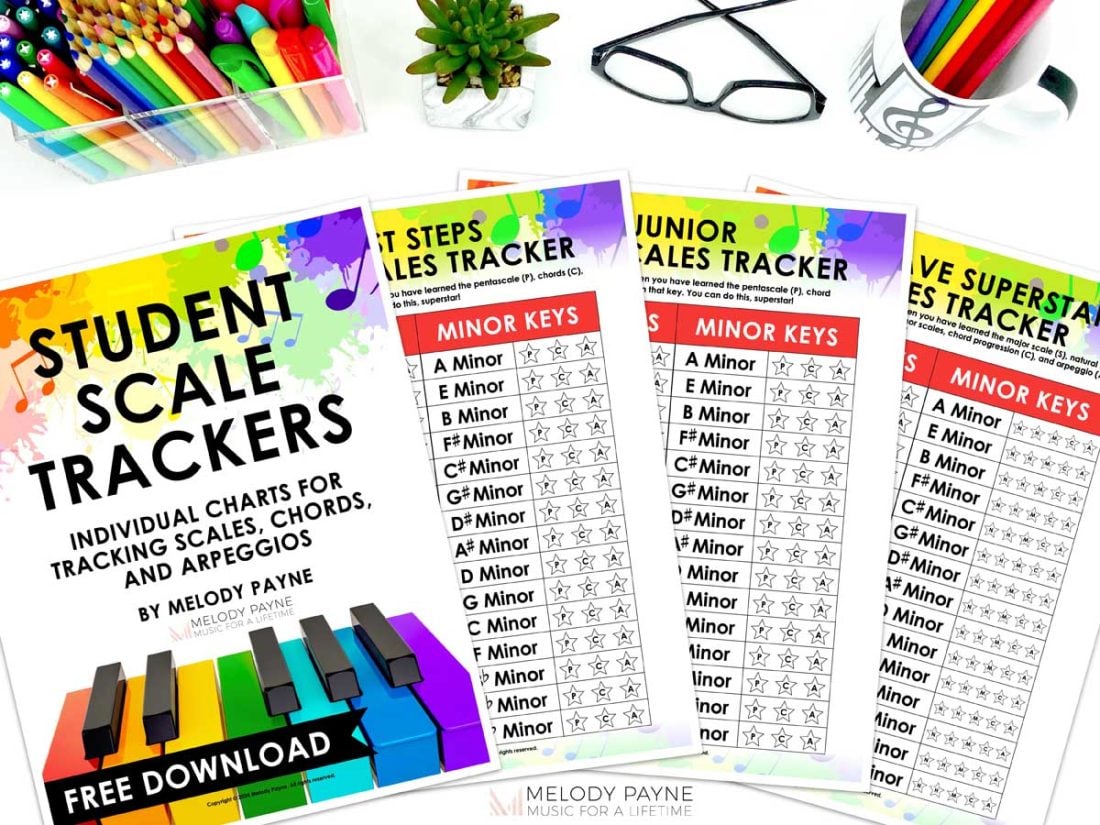
In this free download, there are 4 actual trackers:
- First Step Pentascale Trackers (for alphanotes)
- Includes coloring stars for pentascale (P), chord (C), and arpeggio (A)
- All 15 major and minor scales
- Junior Pentascale Trackers
- Includes coloring stars for pentascale (P), chord (C), and arpeggio (A)
- All 15 major and minor scales
- 1 Octave Scale Trackers
- Includes coloring stars for major scales (P), chords (C), and arpeggios (A)
- Includes coloring stars for natural minor scales (N), harmonic minor scales (H), melodic minor scales (M), minor chords (C), and minor arpeggios (A)
- All 15 major and minor scales
- 2 Octave Scale Trackers
- Includes coloring stars for major scales (P), chords (C), and arpeggios (A)
- Includes coloring stars for natural minor scales (N), harmonic minor scales (H), melodic minor scales (M), minor chords (C), and minor arpeggios (A)
- All 15 major and minor scales
As you can see, this major and minor scale tracker PDF is perfect for your entire studio!
Each student can get their own scale tracker and start working on learning ALL of the major and minor scales, chords, and arpeggios, coloring the stars to track progress.
Then, when a student has completed the first level scale tracker page, they can move on to the second, third, and fourth!
Get the free Superstar Scales Tracker here!
2. Encourage individual practice with the major and minor scale tracker PDF
I am a very goal-oriented musician.
When I was learning piano, my teacher would write down all of the keys I knew and every day when I practiced, I would mark it off the list.
It was very fulfilling!
How much better would it have been to have a fancy page to color and keep track?
For those goal-oriented students, you can either print a PDF each week for them to color, slip the page in a clear plastic sleeve where they can dry-erase it weekly, or upload it to their tablet where they can digitally mark it off their list.
3. host a Studio-wide challenge with the major and minor scale tracker pDF
What better way to learn all of the major and minor scales than with your peers?
Have a studio-wide challenge where your students can see each others’ progress and cheer them on.
You can use the major and minor scale tracker PDF for each student and the studio major and minor scale trackers for everyone’s weekly records (10, 20, and 30 students per tracker that can be printed on regular paper or up to 17 x 22”!).
For more studio-wide challenge ideas, read How to Host a Piano Practice Challenge and Develop Strong Sight-Readers with “The Great Sight-Reading Challenge”.
4. review scales with the scale tracker pDF

I don’t know about you, but once my students have learned their scales, chords and inversions, I want them to regularly review them.
Not only is it essential for them to remember their scales if they continue to college, it is also helpful for the student to review their scales regularly to remember finger numbers, key signatures, and more.
These major and minor scale trackers are perfect for those students who have learned all of their scales and just need to review them.
Print off a page and see if your student can color in all of the stars in one week’s time (or, for your more relaxed-paced students, have the goal of coloring in all the stars in one month).
5. Use the major and minor scale Tracker PDF for Transfer Students’ Skill assessment
There are so many things to figure out with a transfer student, and the major and minor scale tracker PDF will help you as you assess your new student’s skill!
Send the appropriate level Superstar Scales book home with the student and ask them to color in all of the scales, chords, and arpeggios they understood.
Then, work with them on those scales, chords, and arpeggios the following lesson, making sure they actually do understand the correct notes and finger numbers.
I would ask them to color with a light color (e.g. yellow, light blue, pink), and then when I’m listening to their scales, I’d color over it with a darker color to verify they know it.
If you have to reteach some scales, then you can use the scale tracker PDF to easily see what light colors remain that your student needs extra practice on.
6. Do a Metronome challenge
One of my teachers had the goal of playing all 12 major scales in under 5 minutes (2 octaves up, 2 octaves contrary motion out-in, 2 octaves down).
That was such a fun goal – I loved it!
I did a lot of metronome practice in order to achieve that goal with correct finger numbers and proper dexterity.
If you want to do a speed challenge with your students, then use a major and minor scale tracker PDF for them to color when they have reached their metronome goal.
(Looking for a good metronome? Check out our blog post, How to Choose the Best Metronome for Your Piano Students)
7. Have fun with a Rhythm challenge
One of my favorite ways to review scales is with various rhythms and techniques.
Here are a few you can try:
- Long short-long short-long
- 3 notes then pause (one two THREE… one two THREE …)
- Slur-staccato (“drop-roll”)
- Repeated notes (C C C D E E E F G G G, etc.)
- Repeated notes with syncopation (C C-hold C D D-hold D E E-hold)
You can either color code rhythms for students to mix and match (they can’t do two the same in a row!) OR you can have them work through the entire page with one rhythm then start over with another rhythm.
For more rhythm ideas, check out The Best Rhythm Game for Teaching Rhythm Skills
8. do Improv or composing with the major and minor scale tracker PDF
This tracker provides a golden opportunity for students to improv or compose.
Are they in the key of C? Then encourage the student to include a scale, chord, and arpeggio somewhere in their improv (and you can color it when you hear it).
If they are more advanced, you can use the scale tracker to encourage composition.
Can they write a piece including all three minor scale forms, the minor chord, and arpeggio?
With this method, you can take your student through all the keys with improvisation or composing!
If you need help getting started with improvisation or composing, check out 5 Good Reasons To Teach Piano Students How To Improvise and Easy Composition Activity for Beginning Piano Students.
9. encourage major and minor Ear training
Your students don’t need to be advanced to start learning how to hear and identify their scales, chords, and arpeggios!
Use the 1-octave or 2-octave scale tracker chart.
Have the student turn their back to the piano.
Tell them what key you’re working on (e.g. D).
Play one of the scales, chords, or arpeggios in that key – major or minor!
This means you could play D major scale, D natural minor scale, D harmonic minor scale, D melodic minor scale, D major chords, D minor chords, D major arpeggios, or D minor arpeggios.
When the student identifies it, they can color the correct star.
Once you work your way through the entire chart, your student will be able to hear all of the differences easily!
10. Modulate with 7th chords through the entire major and minor scale tracker PDF
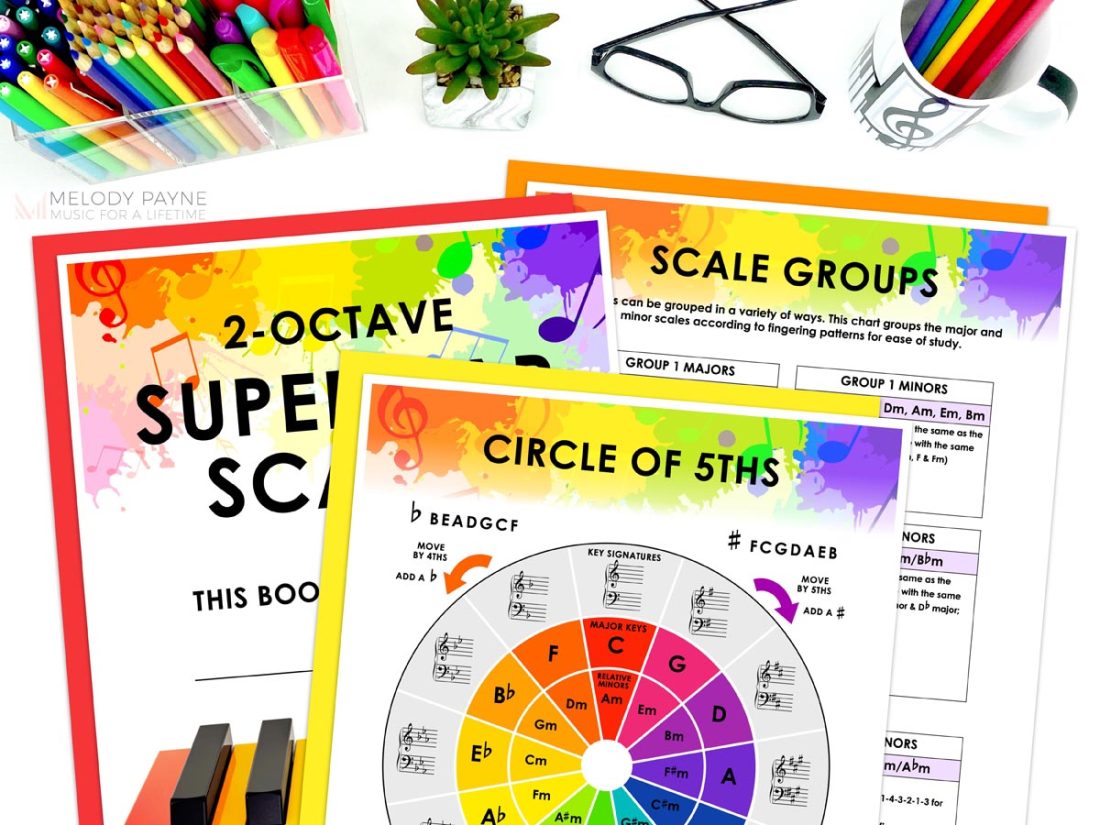
One of the best tools to provide a student is how to modulate around the Circle of Fifths.
If you’ve never been clear on modulation or key changes, the simple rule is:
- What key are you going to? (new key)
- What is the dominant 7th of the new key? (the 7th chord built on the 5th scale degree)
- Play that dominant 7th at the end of the old key, going into the new key!
Your students can work their way through the entire scale tracker by modulating!
For example:
- C major scale
- D7
- G major scale
- A7
- D major scale
Or you can go backward
- C# major scale
- C#7
- F# major scale
- F#7
- B major scale
Once your student has worked through their scale tracker a few times, they will know exactly how to modulate to every key!
What ideas do you have for using the major and minor scale tracker PDF?
We’d love to hear what ways you’d use the tracker! Let us know in a comment!
Superstar Scales for All levels!
If you need an easy way to help your students become scale superstars, then check out the Superstar Scales series!
Superstar Scales are important because students will experience each scale in several ways:
- See the scale on the piano keys by coloring the keys
- Say/spell the scale by writing the letter names
- Read the notes of the scale by looking at the score
- Feel the scale as they play it
- Hear the scale as they play it
More creative teaching Blog posts…