


Inside: Simple games that make improvisation feel safe and approachable for even the most apprehensive piano students! These Music Spelling Bee games use note reading cards with words like ACE, FADE, and AGED to give students specific “rules” and boundaries for their first improvisation experiences. Students identify piano keys or staff notes to spell musical words, then create melodies using those letters – from simple B-E-E patterns across the keyboard to more complex intervallic arrangements. Your students will discover they can be creative and express themselves musically without intimidation because they have clear guidance and boundaries to work within!
Table of Contents
Can you use games to teach piano students to improvise?
If you’ve read my last two blog posts about teaching piano students to improvise, then you’ll know I’m a big fan of using games (read 5 Good Reasons to Teach Piano Students to Improvise here and 3 Advantages of Using Games to Teach Piano Improv here).
As piano teachers, we all want to help our students develop a wide variety of musical skills.
One of the most powerful and rewarding ways to do this is by introducing improvisation into their piano lessons.
Improvisation is a fabulous skill for piano students of all ages to develop.
It allows students to express their own creativity and musical ideas, helps build their confidence, increases their understanding of music theory, and so much more.
Plus, improvisation provides an easy way to infuse something new into piano lessons, and a safe way for even the most apprehensive students to succeed with a little guidance!
Today, I share what games you can use and also have a video where I share how I use games to teach piano students to improvise.
This is part of our blog series on teaching improvisation to piano students.
Subscribe to our newsletter here so you will get all future blog posts in this series.
What Games Should We Use To Teach Piano Students To Improvise?

My absolute favorite games for introducing students to improvisation are the Music Spelling Bee Games.
These games are originally designed to strengthen piano keys and treble and bass clef note reading, but they can also be used as the perfect introduction to teach piano students to improvise!
There are several different versions of the Music Spelling Bee Games, each with its own unique benefits.
The easiest game involves identifying the white piano keys, and the most advanced is having students identify treble and bass clef notes up to 3 ledger lines above and below the staff.
Music spelling words created from the letters of the music alphabet are shown on each card: ACE, FADE, BEAD, DEEDED, and DECADE, for example.
Once students have identified the piano keys or notes on the staff, they will use the letters of that music spelling word to improvise a short melody.
Watch this video to learn how to use the Music Spelling Bee Games to teach piano students to improvise (watch time 3:48).
Transcript
Can you teach improvisation through games?
I’m here to tell you that of course you can!
This is something that has come up recently in my studio and I wanted to show you a quick and easy way to play games in your piano studio while teaching improvisation to your students.
Teaching Improvisation: Fun with the Music Spelling Bee Game
First, I want to show you this card from the first level of the collection of games called Music Spelling Bee.
This card reviews piano keys, and you can see that three piano keys are colored in.
The beginning piano student who is working on their piano keys will identify these three piano keys, which in this case are B-E-E.
What you would do is have your student identify these keys, tell you what the word is and then the very first time that you’re teaching that student how to improvise, you could demonstrate something very easy on your piano.
They can play B, E, E all the way up the piano or get creative and press the damper pedal to play each note (B, E, E) in different registers.
So, improvisation doesn’t have to be perfect.
It can actually be a very easy exercise that you can incorporate seamlessly into your piano lessons.
Transitioning to the Middle C: Opening More Doors
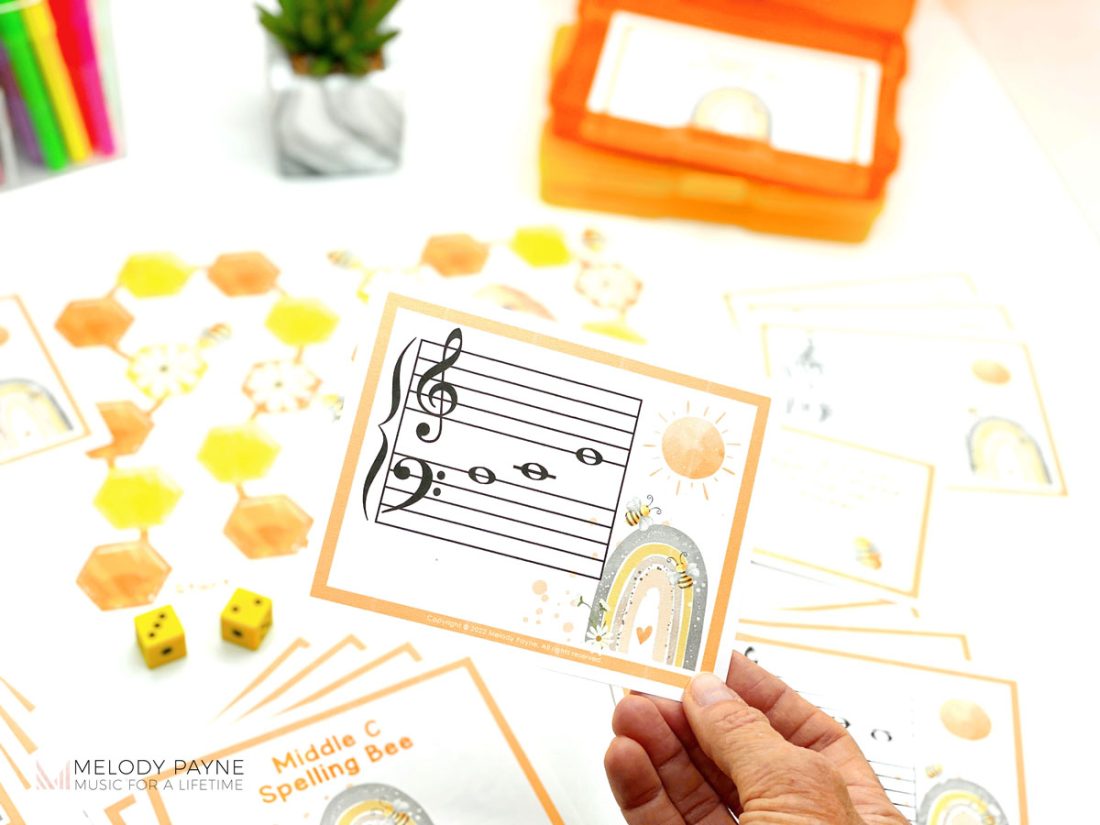
Now, if your student is reading comfortably in middle C position, the Middle C Spelling Bee Game would be the set that you could choose.
For example, this card spells the word ACE.
This gives us the opportunity to add a left hand note.
They might want to play an A then C and E together, using the pedal to create something unique.
Or they might want to do an A minor arpeggio with a pedal, or even something a little bit more abstract like A down low, C up high, and E in the middle.
Once again, remember that improvisation doesn’t have to be hard and scary.
Beyond the Basics: The Ledger Line Set
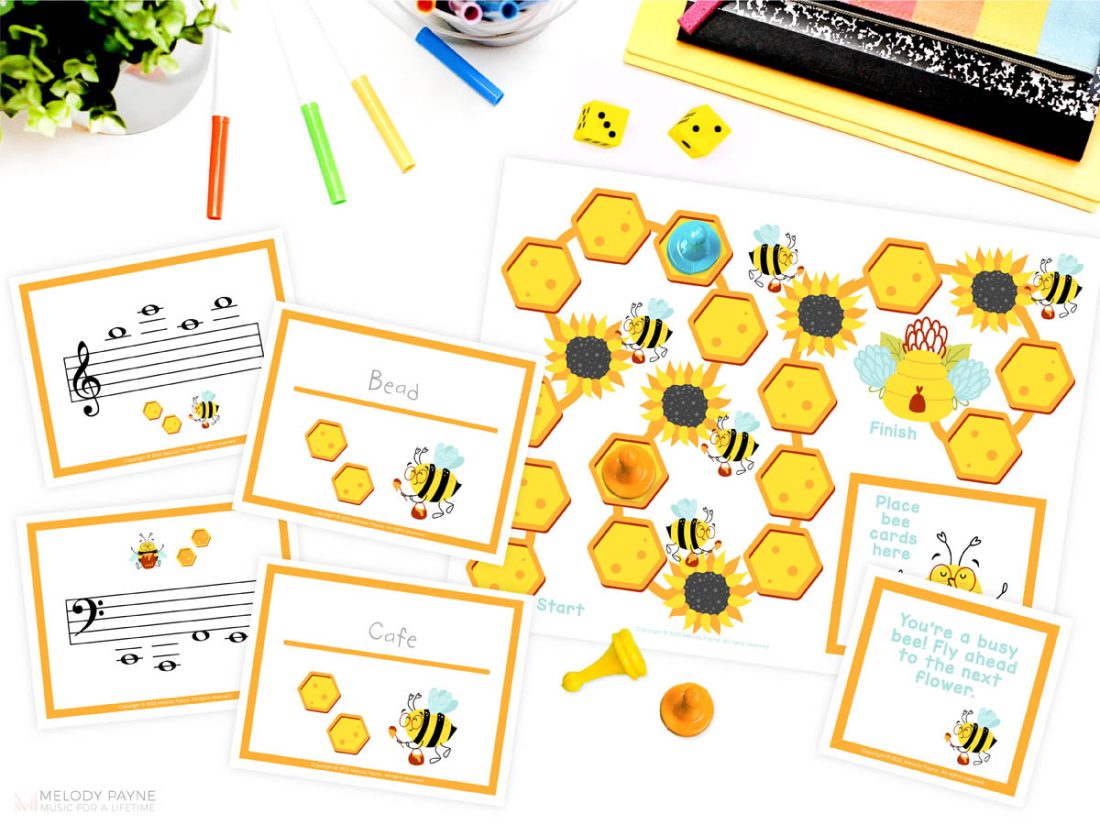
Now, here is one more card that I am going to show you today.
This is a card from the Ledger Line Spelling Bee set, the treble clef ledger set.
And in this case, the word spells A G E D, aged.
This gives us the opportunity to play some intervals like A and G together, and E and D together, which could be really beautiful.
And that’s just a beautiful little improvisation using the letters of the word age from this music spelling card.
Turning Games into Improvisation: The Final Takeaway
That is how you can use all of the games in the Music Spelling Bee series to teach your students how to improvise in a very easy, fun, and safe way so that they don’t feel intimidated by the process of making up music on the spot.
This is a great way to give them some guidance–to give them some boundaries for the students who feel more comfortable inside of the boundaries–like I always did when I was a child, and it gives the students a way to express themselves musically in a way that they may never have done before.
(end of transcript)
Do You Use Games To Teach Piano Students To Improvise?
By incorporating the Spelling Bee games into your teaching, you can help your students build their improvisation skills gradually, with a focus on having fun.
So if you’re a piano teacher looking to inspire your students and encourage their musical creativity, why not give Music Spelling Bee Games a try in your next lesson?
You may be blown away by the results!
And if you already use games to teach piano students how to improvise, what do you use?
Or do you teach improvisation in your piano studio a different way?
Comment and share your ideas!
More blog posts with creative teaching ideas



2 Responses
What great ideas, Melody! The video was very helpful, and I like how you give the students something to get them started. I have in the past used picture cards to let students improvise, but they are often intimidated to actually start playing anything. Thank you for sharing all the ideas in this post!
Thanks so much, Barbara! I’ve found that some students are much more likely to give improvisation a try if I can give them more specific “rules” they can follow. This can free them up for more exploration at the piano and open the door to a whole new world for them! 🙂