


Inside: Three game-changing solutions that solve the biggest piano game organization challenges teachers face! You’ll discover how to overcome “out of sight, out of mind” with master lists and decorative labeling, separate games by function (individual lessons vs. group activities), and handle different-sized materials without forcing everything into one storage format. Your games will finally get used regularly because you’ve created a thoughtful system that puts the right activities at your fingertips exactly when you need them – no more forgotten resources sitting unused in drawers!
Table of Contents
Guest writer Amy Chaplin shares from her experience with how you can organize piano games and manipulatives in an easy way that will inspire you to use them regularly!
If organization isn’t your strong suite, don’t let it scare you away from reading this helpful article!
Do you ever tire of hearing tips on how to organize piano games or store teaching manipulatives?
As an independent teacher, I imagine few if any would answer yes to this question, and for valid reasons.
There are many layers to what we manage on a day-to-day basis, including, but not limited to, studio family contact details and payment processing, student repertoire history, daily lesson planning, sheet music (physical and digital), and teaching resources, tools, games, and manipulatives.
Each layer requires its own management plan, which can make it feel overwhelming….and thus continues the conversation cycle.
In 14+ years of owning my piano studio, how I manage any of these areas has never stayed the same. There are always little fluctuations.
The key to organizational sanity, in my opinion, is maintaining the mindset that:
- There’s no perfect or one-size-fits-all solution.
- What’s working today will likely need to be reconsidered at some point and sometimes not by choice (e.g., the dissolution of the Tonara practice app and Coinhop payment processing app.)
- It may not be practical to make the organization of one category fit into one format/strategy. (e.g., all your games fit into photo box containers, or all your sheet music to fit into magazine holders).
In this article, I’ll share three specific organizational problems and solutions to consider when organizing one of these areas: teaching tools, games, and manipulatives.
You’ll walk away with specific ideas on organizing these items and, even more importantly, a healthy mindset to guide your organizational needs moving forward.
Getting Started with organizing Piano Games
I struggled to remember how I started to organize piano games and manipulatives, so I consulted my favorite memory medium: Google Photos. LOL.
Luckily, I came across a photo from the first year of my full-time studio (I taught for 12 years on the side before dedicating my career to piano teaching).
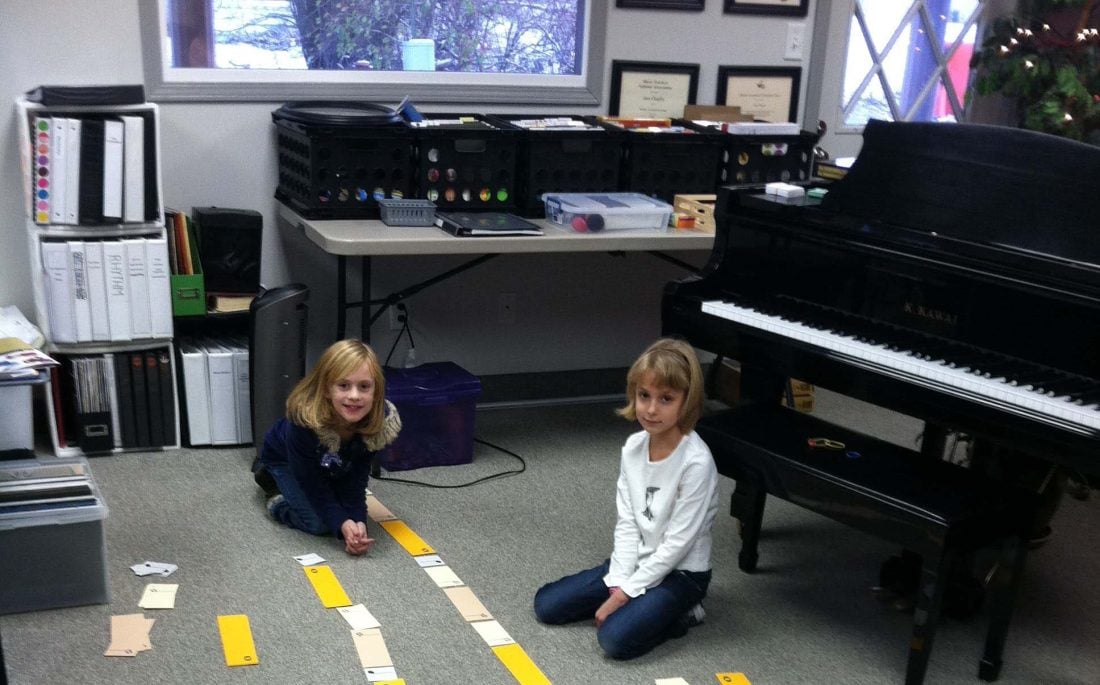
(On a side note – these two gals hold a special place in my heart as they were the first students to sign on with me when opening my business. The one on the left is now my online assistant while she works on a digital marketing degree, and the one on the right is a piano performance major. So special!)
Behind these sweet girls on the left, you’ll see binders full of worksheets organized by category, such as rhythm, intervals, etc. I no longer use physical worksheets like this, so this organizational need is now defunct for me!
On the right is a folding table with plastic crates containing file folders housing information for students and games. (This was before I had the money for pretty storage solutions, LOL.)
There’s also a plastic storage container sitting there for game markers, etc.
Luckily, this messy area didn’t last long, and I upgraded to some real storage solutions.
It’s hard to see fully in this photo, but my new cube system was flexible in function. It had space for file folders, binders, magazine holders, and storage cubes.
Problem / Solution #1 to organize piano games: Out of Sight, Out of Mind
Even with this nice storage system, one problem I struggled with was “out of sight, out of mind.” It was so easy to forget what I had!
I came up with two solutions for this.
First, I created a master list of all the games and resources, so that when I planned, I didn’t have to constantly get up and go to my game drawers to see what was available.
Second, I labeled the file folders in a decorative way that fit the game, making it easier to remember what was inside each folder. I even labeled the category on the outside of the drawer.

I loved this solution because I could keep file folders and organize piano games of all sizes and loose stuff in the same place by topic category. This worked for a LONG TIME, and I loved it (until I didn’t).
Problem / Solution #2 to organize piano games: Function and Access
Years later, after becoming mildly obsessed with some narrow plastic magazine files and hearing about plastic expandable envelopes from Nicola Cantan, I started moving out of the file folder format and into using a combination of clear slim and expandable plastic folders and magazine holders.

This format to organize piano games still allowed for flexibility in storing items of different sizes and shapes while keeping everything in categories and within sight.
The downside I ran into was that games that were only good for more than one student were mixed in with those that worked best in a solo setting, and I found myself not utilizing items during lessons.
I needed even easier, quick access during lessons.
At this point, I realized that not all games and manipulatives are created equal—they serve three different purposes.
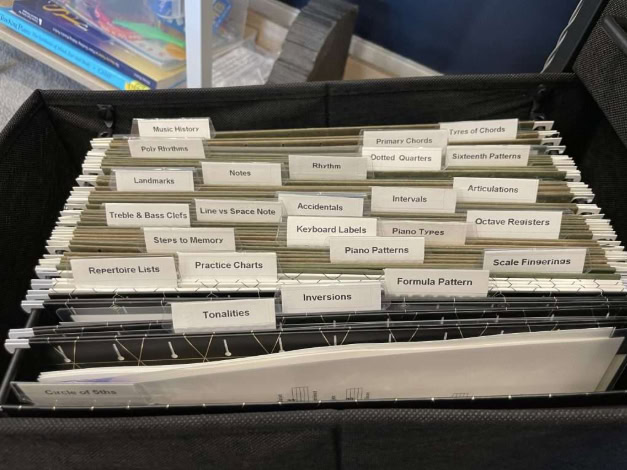
The first is teaching tools that you might use when teaching new concepts.
For me, these are sometimes just a single-page view, like scale fingering sheets, keyboard label stickers, or an overview of landmark notes. I like keeping these in a file drawer next to the piano, clearly labeled.
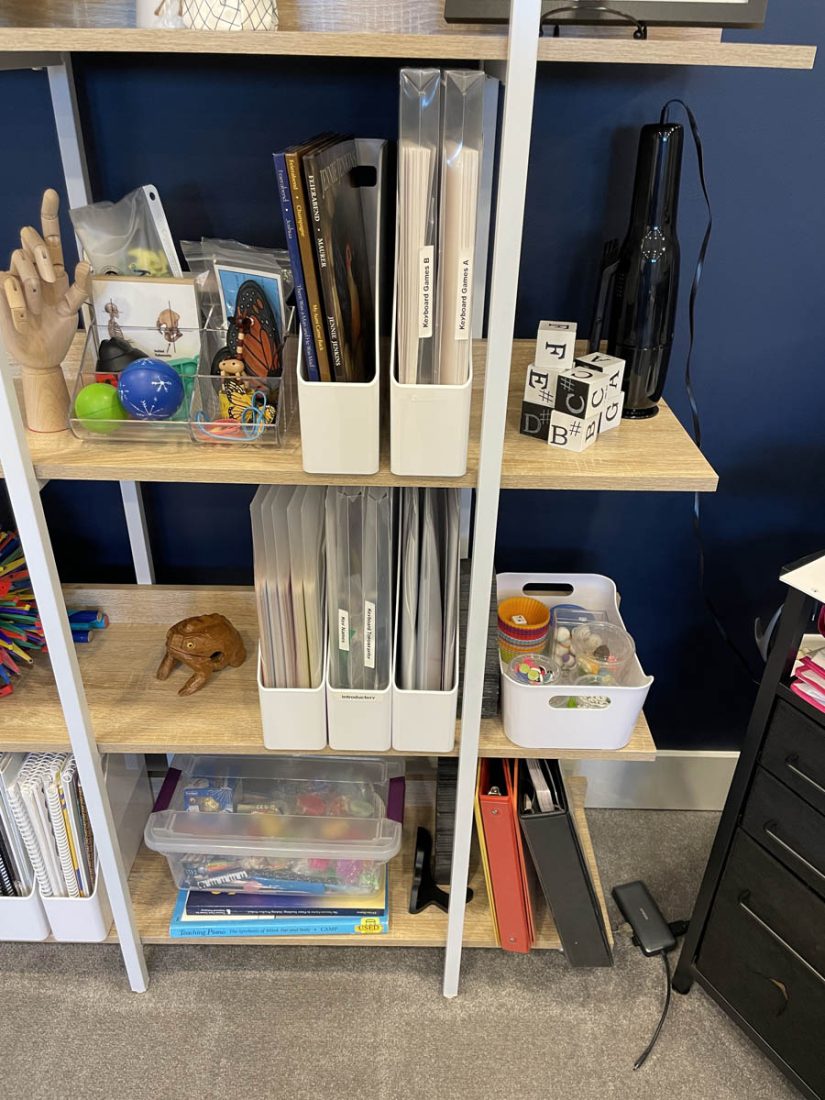
The second is actual games and manipulatives that I am most likely to use with individual students during individual lessons.
Most of these are related to beginning concepts like technique, keyboard topography, finger numbers, and rhythm patterns.
I still keep most of these in magazine holders, but separate them from games that are best for more than one student and place them on my bookshelf next to the piano.
In this photo, you’ll also see game markers in a white plastic caddy and technique manipulatives in another clear plastic caddy.
(The big clear plastic tub on the bottom shelf is my prize box, which is only used for competitive group class games these days.)
You could argue that the first and second functions I mentioned are the same—things you do at the piano with the student.
Either way, the idea is to separate items that you use more spontaneously during individual lessons from those you would only use in a group setting.
If a grey area exists, pick whichever way you are most likely to think about that game or activity.
Problem / Solution #3 to organize piano games: The Right Size
As I mentioned in the introduction, one part of your healthy organization mindset is to accept that it may not be practical to make the organization of one category fit into one format/strategy. (e.g., all your games fit into photo box containers, or all your sheet music to fit into magazine holders).
While the plastic expandable envelopes are beneficial in that they allow multiple-size items to be nicely contained together (see photo below), sometimes the game cards or supporting material that goes with an activity take up so much space that it doesn’t allow room for all the games in that category to fit into the same magazine holder.
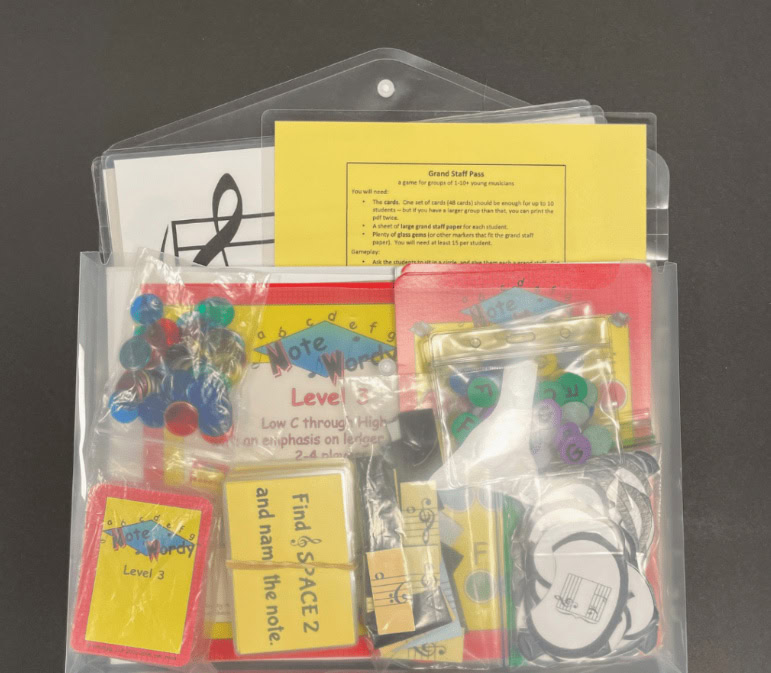
Case in point – this game (from the now obsolete Pianimation website) has a set of several cards that go along with the game. They just took up too much space in the plastic folder and magazine file so I separated them.
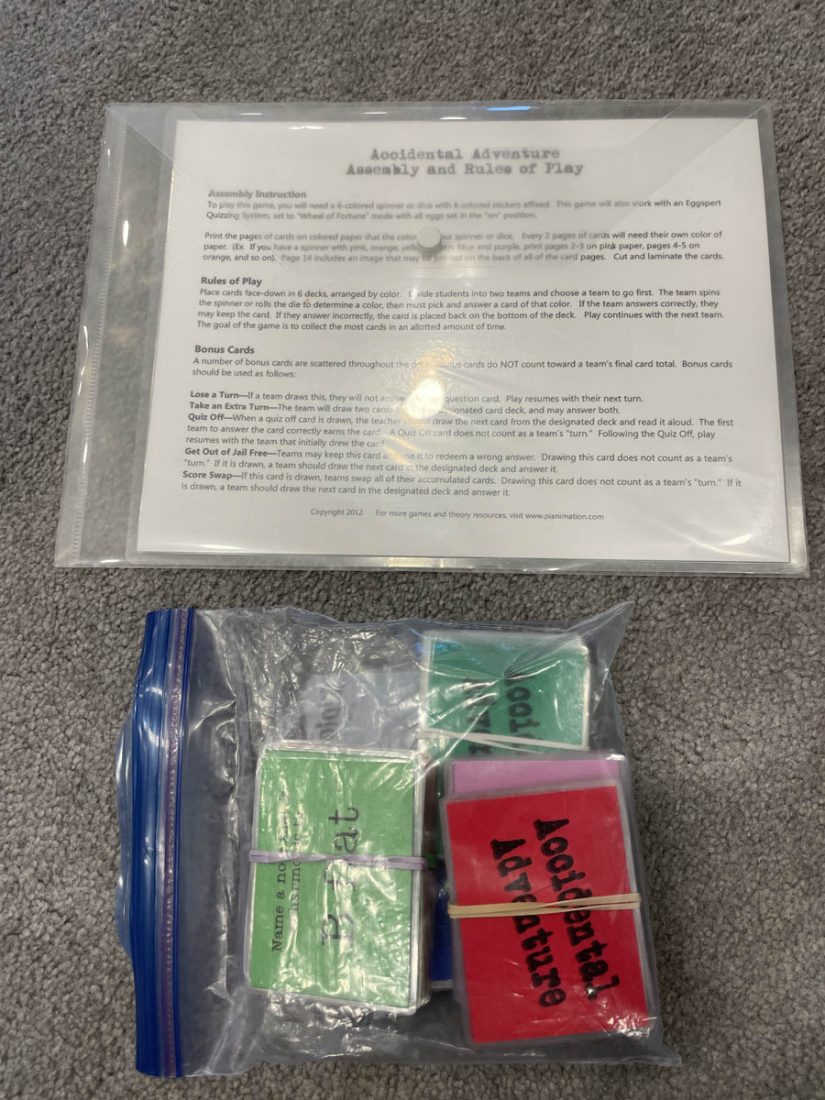
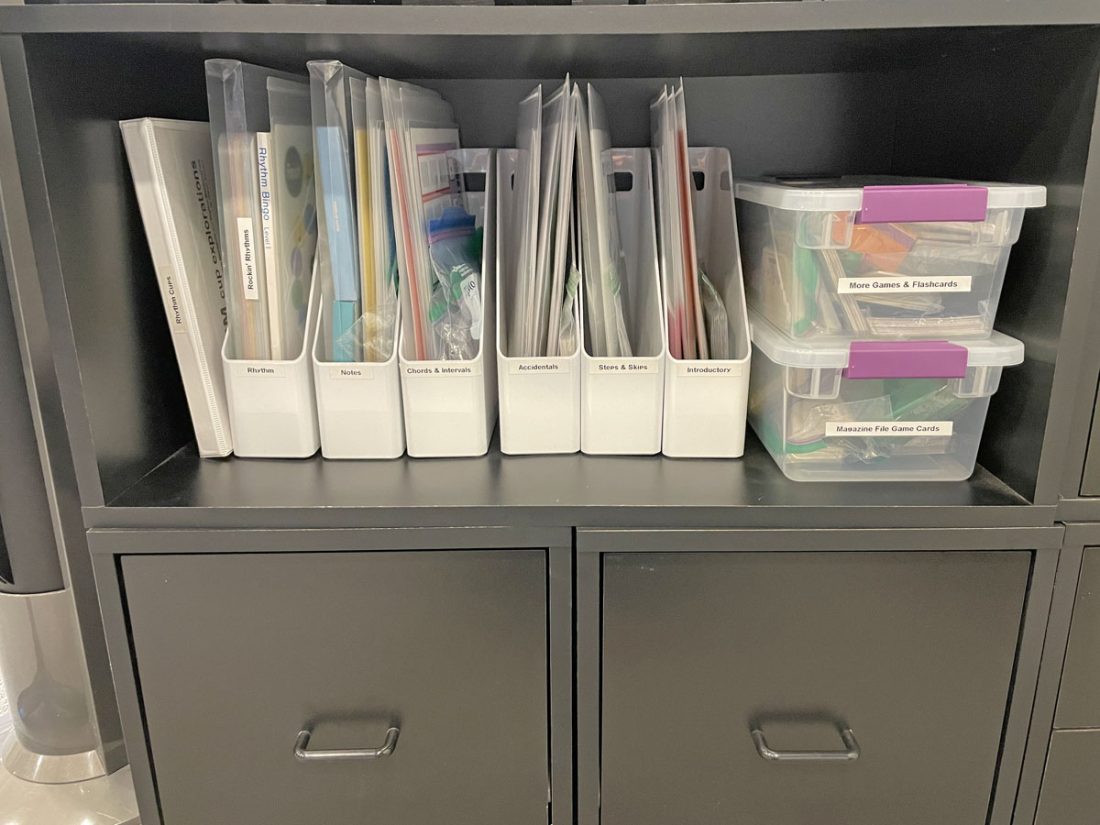
My goal was to do my best to keep all games in one category within the magazine holder so I knew the full breadth of what was available for one concept (like accidentals).
The solution was to store the full-size page—whether the game directions or the playing board—in a thin plastic sleeve and store the large card sets inside a small tub labeled “Magazine File Game Cards.”
Luckily, most of the games are still together in the plastic envelopes—only a handful needed to be separated to maximize storage space.
In Conclusion
It’s not perfect, but it’s a process and, as I hope you saw in this article—a thoughtful one.
While the specific way I organize piano games and manipulatives may not work best for you, I hope these three problems and solutions I worked through have helped you as you consider what storage solutions work best for your space and teaching style.
I’d love to hear… how do you organize your games and manipulatives? Which of these ideas do you think would work great for you and your studio?




2 Responses
Thanks for your thoughts on piano game organization. I also find that not everything fits the same way and I don’t use them when they’re out of sight. But I also like keeping them tidy so they’re not everywhere. I feel like I haven’t been effectively using all my games — maybe cause they really need to be re-organized to be functional.
I’ve found that when my games are in sight, some of my very young kids get distracted by it. So I got cupboards for my square shelves..etc Haha…and then now I don’t remember them!
I need a Games Overhaul day…or week!
Yes, it’s an interesting cycle (and fine line) of having just the right access so you don’t forget about them but also keeping them in a place that’s not distracting. LOL