
Inside: Research-backed strategies that make chords and inversions click for students through collaborative learning and step-by-step instruction! In this blog post, you’ll discover how students learn chord patterns more quickly when working together, creative ways to keep practice interesting (like asking “How would a dragon play these chords?”), and how to connect new inversions to familiar music in their repertoire. Your students will light up when they finally understand chord shapes and feel confident playing progressions because you’ve built their skills one solid step at a time!
Table of Contents
Make Teaching Chords and Inversions Easy with These Proven Strategies
Do you find yourself wishing your piano students would practice their chords and inversions more?
Piano teachers often tell me they’d love to incorporate more chords and inversions into weekly lessons, but they struggle to find engaging ways to present them to their students.
Teaching chords and inversions can become one of the most rewarding parts of your piano lessons, and here are some strategies that will lead to success.
Proven Strategies for Teaching Chords and Inversions
I absolutely love seeing how students light up when chords and inversions click for them!
Through my experience teaching chords and inversions, along with research in piano pedagogy (Li, 2019), I’ve discovered some terrific insights about how students grasp these concepts.
One of my favorite insights is that students learn chords more quickly when they combine collaborative learning with step-by-step instruction.
So what does this mean for us as piano teachers?
I believe it means we can gladly teach chords and inversions in private and group classes, and introduce them step by step for the very best results!
Collaborative Learning for Teaching Chords and Inversions
Did you know that students who are working together master chord patterns more quickly than those working alone (Andrews, 2021)?
That finding was so exciting to me! When students collaborate, they:
- Remember chord progressions better
- Build confidence trying new patterns
- Understand chord connections more deeply
- Create innovative ways to use their new skills
Maybe it’s time to schedule a mini piano camp all about chords and inversions so your students can work on them together!

Step-by-Step Strategy for Teaching Chords and Inversions
In addition to students learning more quickly by learning together, just like a house needs a strong foundation, students learn chords best when they solidly build concepts one on top of another.
I love helping my students make progress step by step.
Breaking things down into simple steps for my students is actually one of my favorite things to do!
Here are a few ideas for a step-by-step process for teaching chords and inversions in a way that is relevant and goal-oriented:
- Start with only basic root position triads (the first time a student plays a triad successfully is so significant and exciting!).
- Then add first inversion chords to the root position triads they have learned.
- Then add second inversion chords only when they are completely ready.
- Give them plenty of time to practice each step until they feel 100% confident and secure.
- Create fun variations to keep things interesting for them.
- For younger students, I might ask, “How would a [insert your favorite animal or mythical creature here – one of my students is obsessed with dragons] play these chords?”
- Or “How would you play these chords if you were in a [insert a mood such as cranky, silly, goofy, etc.] mood?”
- Explore the inversions found in common chord progressions, starting with the most basic I-V7-I.
- Connect new chord inversions and chord progression patterns to familiar music they already know how to play .
- “Oh look! Those are the same chords you’re playing in your sonatina!”
- “Do you recognize these chords from your hymn book?”
- Break longer chord progressions into smaller, more manageable pieces.
- Work incrementally towards learning and understanding the inversions of the chords in an entire chord progression, starting with I-V7-I and I-IV-I-V7-I.
- Show students how to use their chord skills in music they love, such as lead sheets of their favorite pop songs or praise and worship songs.
- Give them the freedom to experiment with different inversions as they learn to play each lead sheet.
This approach helps me make sure that my students have spent enough focused time on each individual step to build tons of confidence, which helps them feel secure in their skills and eager to try the next step.

Two Games for Teaching Chords and Inversions
Some students see chords as shapes on the keyboard before they understand the music theory behind the chords.
I was one of those students who saw and felt chords as shapes on the piano keys, especially when I was playing from the hymnal.
This part of the learning process can help us:
- Guide our students to use the chord shapes as anchors on the piano keyboard (“you’ll always be able to recognize root position chords because they are shaped like this”)
- Show consistent finger number patterns they can rely on (“first inversion chords will use these specific finger numbers”)
- Connect similar chord shapes across different key signatures, which can also help strengthen sight-reading skills
Here are two quick and easy activities that reinforce the specific shapes of each chord and its inversions.
- Chord Challenge:
- Ask students to place either their right hand or their left hand on a C major chord in root position.
- Challenge students to plan ahead and name the finger numbers they will use to play the first inversion (and then the second inversion) chord before they actually play it.
- This helps them play efficiently and develops their awareness that different finger numbers are used for root position, first inversion, and second inversion chords.
- Students love competing to see who can play all of the chords and inversions with the fewest finger number errors.
- For even more fun, your students could try this activity with their eyes closed!
- Chord Connection:
- Close the fallboard (keyboard cover).
- Ask students to place one hand on an imaginary root position chord.
- Call out different inversions for students to “play”, focusing on how the shape of each inversion feels under their hand.
- This builds muscle memory for the different chord shapes for each inversion.
- For a challenge, ask students to place both hands on imaginary root position chords.
- For even more fun, have your students create the chord shapes with their eyes closed!
Take Teaching Chords and Inversions to the Next Level
Ready to start using these strategies for teaching chords and inversions with your students?
Start with just one activity this week and use it (or an adapted version of it) with as many of your students as you can.
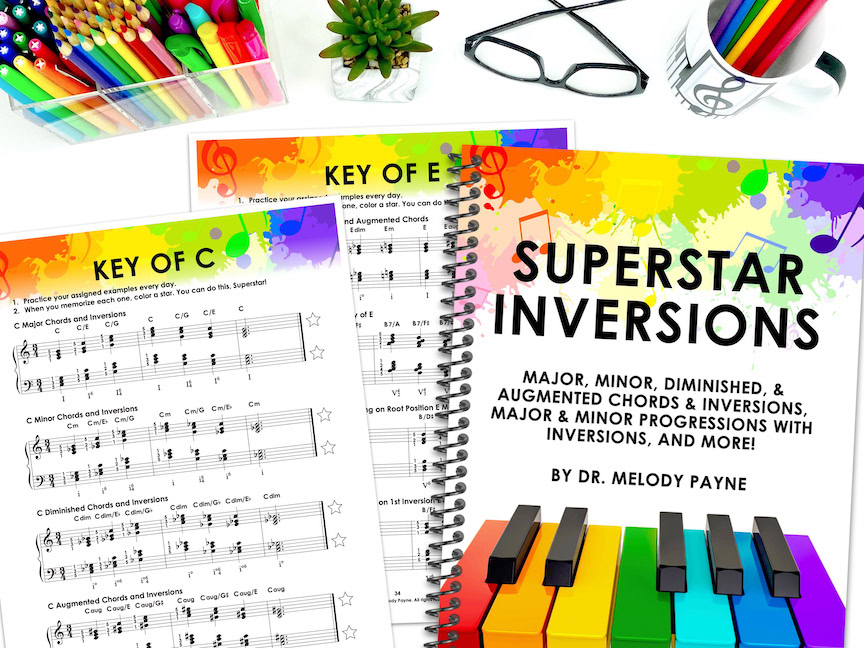
Want to make teaching chords and inversions even easier? You’ll love my Superstar Inversions book – a comprehensive resource you can use with these teaching strategies!
Superstar Inversions includes all major, minor, augmented, diminished, and 7th chords and inversions, chord progressions and inversions, and more, and is full of helpful materials to support your students.
Superstar Inversions is available in studio-licensed printable PDF and in single-student licensed hard copy.
What’s your favorite strategy for teaching chords and inversions? Share your tips in the comments below!
Frequently Asked Questions
Q: What age should I start introducing chord inversions to my students?
A: I typically introduce basic root position triads around age 8-9, then add first inversions around age 10-11 once they’re really solid with root position. However, some younger students (6-7) can handle simple root position chords if they have good hand coordination. The key is making sure each step is completely secure before moving to the next level.
Q: My student can play root position chords but gets confused when we add inversions. How do I help them?
A: This is so normal! I focus on just ONE inversion at a time and use lots of visual and kinesthetic cues. We practice the “chord shapes” with hands on the closed keyboard first, then I have them feel how each inversion sits differently under their fingers. Don’t rush – sometimes it takes 3-4 weeks for inversions to really click.
Q: How can I create collaborative learning if I only teach private lessons?
A: Great question! You can still use collaborative concepts in private lessons by having students “teach” the chords to a stuffed animal or pretend to explain inversions to a friend. I also encourage students to practice with siblings at home, or you could organize short group workshops specifically for chord work. Even recording them playing progressions and listening back together creates a collaborative feel.
Q: My students find chord practice boring. How do I make it more engaging?
A: The character variations work wonders! “Play this C major chord like a sleepy bear” or “How would a robot play this progression?” I also connect chords to songs they know – when they realize their pop song uses the same I-V-vi-IV progression they’re practicing, they get so excited! Games like the Chord Challenge with eyes closed also add fun competition.
Q: Should I teach all chord inversions in one key before moving to other keys, or teach root position in all keys first?
A: I recommend mastering root position, first inversion, and second inversion in ONE key (usually C major) before moving to other keys. This way they understand the concept of inversions thoroughly before dealing with different key signatures. Once they’ve got the pattern down in C major, other keys come much more easily.
Q: How do I know when my student is ready to move from root position to first inversions?
A: Look for these signs: they can play root position triads in at least 3-4 keys without hesitation, they understand the letter names of the chord tones, and they can identify root position chords by sight quickly. If they’re still struggling with basic root position concepts, wait! Rushing inversions before they’re ready often leads to confusion and frustration.
References
Andrews, S. (2021). Teaching songwriting and incorporating popular music in beginning group piano (Publication No. 5) [Master’s thesis, Belmont University]. Belmont Digital Repository.
Li, Y. (2019). The effects of collaboration on harmonization in college group piano (Publication No. 4922) [Doctoral dissertation, Louisiana State University]. LSU Digital Commons.