

Musical Instrument Posters and Labels – Boho Watercolor Music Classroom Decor
$6.00
Earn 6.00 Reward Points
Earn 6.00 Reward Points
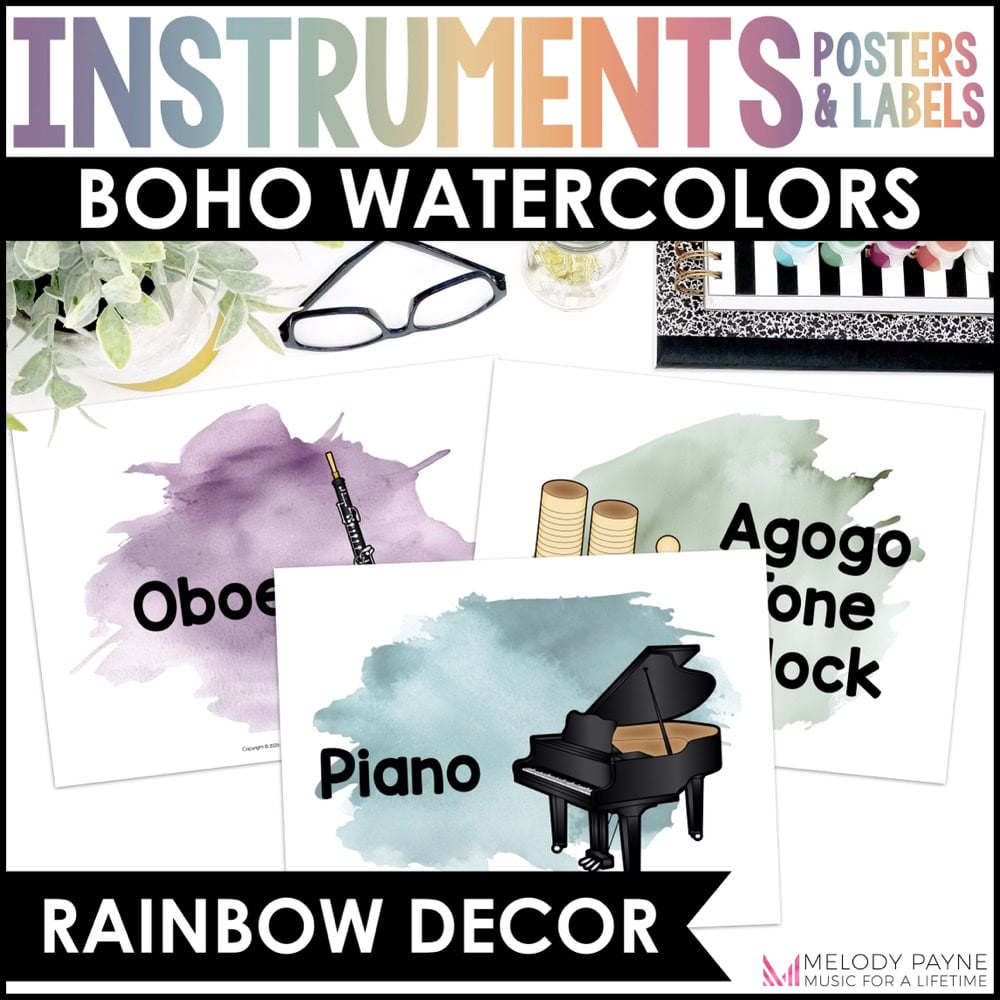
These beautiful musical instrument posters and labels will help your students easily identify and learn 104 different instruments! Students will love exploring orchestra instruments, world music instruments, percussion instruments, folk instruments, and more, and you’ll love how these music education posters build instrument recognition while brightening your classroom. The calming watercolor design will make a perfect addition to your music classroom decor.
Studio License: Unlimited usage with students you directly teach
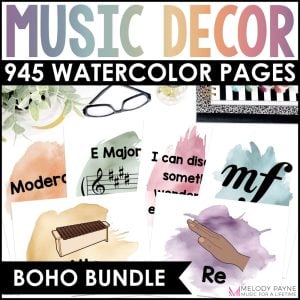
Products included in this bundle:
Description
Help your music students learn and identify musical instruments with this comprehensive set of 104 musical instrument posters and labels. These gorgeous boho watercolor music classroom posters are perfect for elementary music students, piano students, and any music teacher who wants to create an engaging learning environment.
Whether you’re teaching orchestra instruments, band instruments, classroom percussion instruments, or world music instruments, these music education posters will help students recognize and categorize musical instruments from around the globe.
Perfect addition to your music classroom decor, music bulletin boards, and musical instrument identification activities!
What’s Included in This Set of Musical Instrument Posters:
Musical Instrument Posters
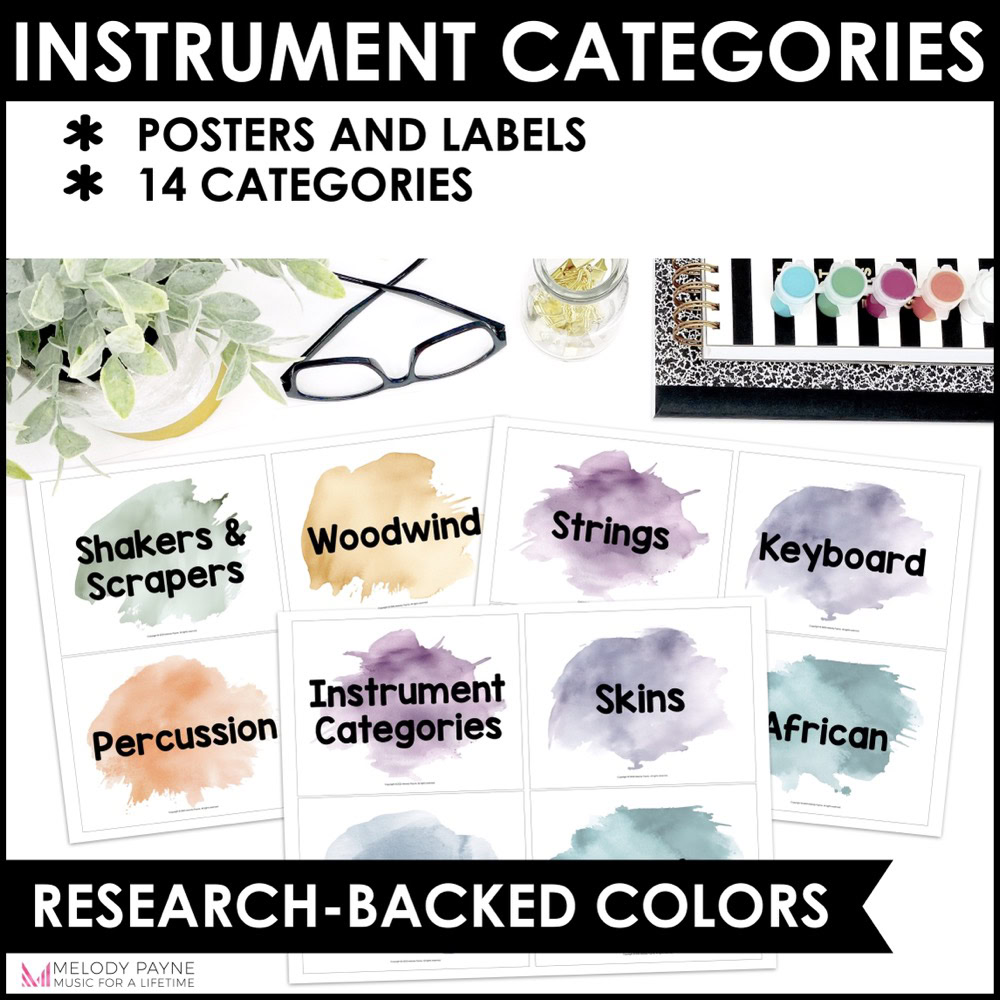
- 14 instrument categories/families posters (woodwind, strings, brass, percussion, etc.)
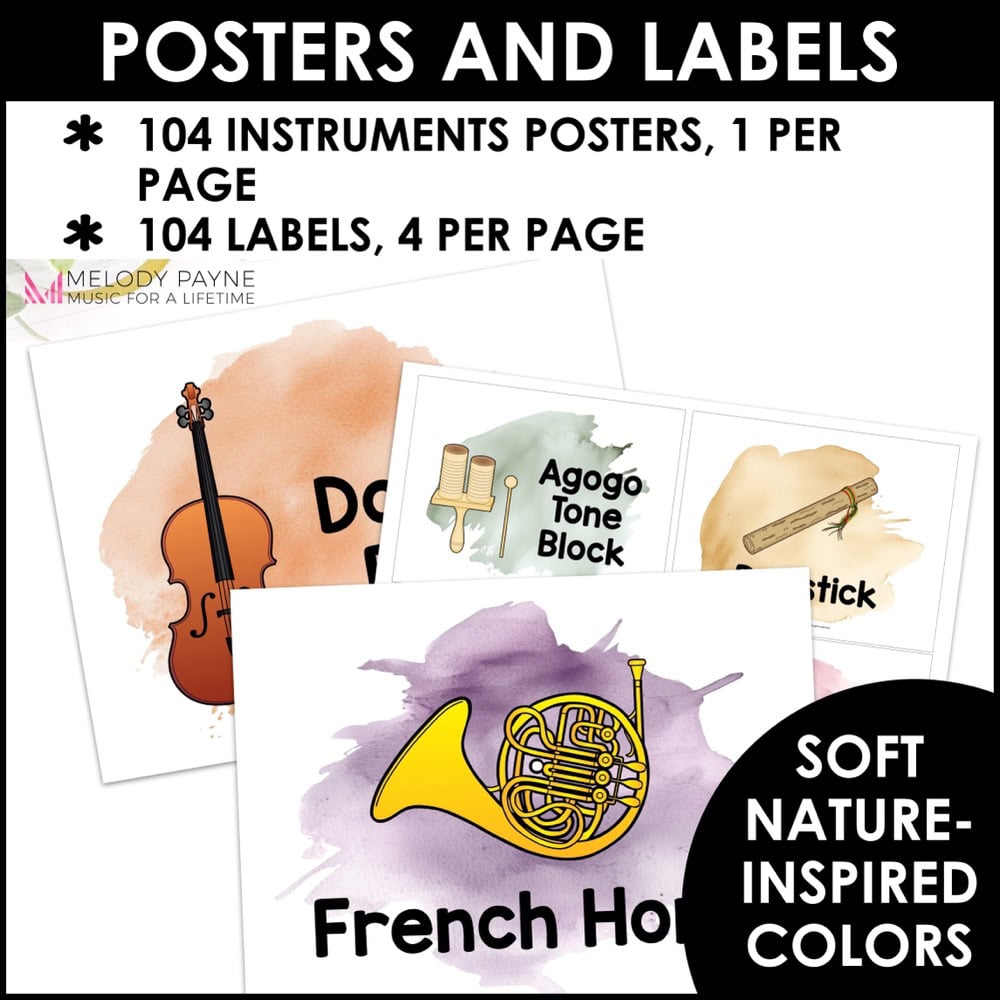
- 104 individual instrument posters (one instrument per page)
- Large, clear images perfect for classroom display
- Beautiful soft watercolor design
- High-quality illustrations showing accurate instrument details
- Perfect size for bulletin boards and music room walls
Musical Instrument Labels
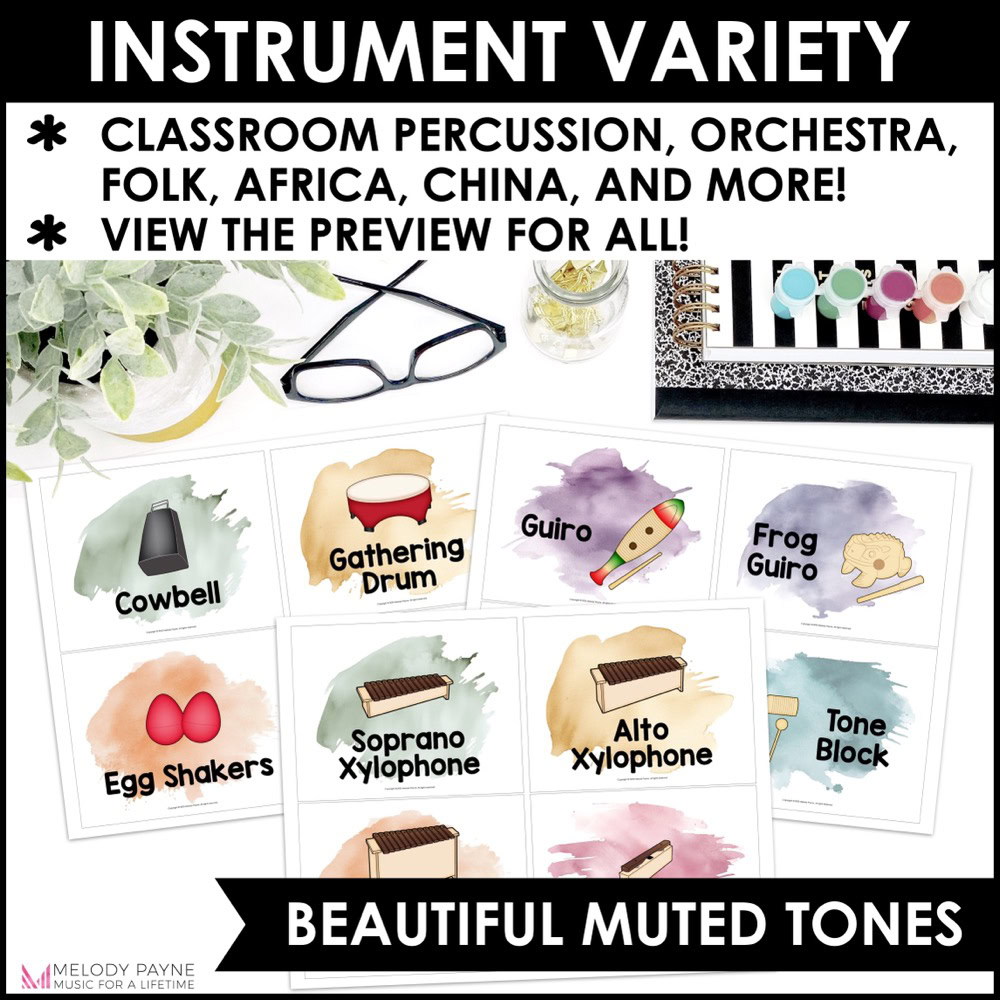
- 104 labels (4 instruments per page)
- Smaller format perfect for sorting activities and games
- Same gorgeous design as the full-size posters
- Ideal for hands-on learning and instrument categorization
- Great for creating matching games and study cards
Complete List of Musical Instruments & Categories/Families
- Instrument Categories
- Skins
- Metals
- Woods
- Shakers & Scrapers
- Woodwind
- Percussion
- Brass
- Strings
- Keyboard
- Orchestra
- African
- Chinese
- Folk
- MISC
- Trombone
- French Horn
- Trumpet
- Tuba
- Pocket Trumpet
- Bugle
- Cornet
- Euphonium
- Saxophone
- Oboe
- Bassoon
- Contrabassoon
- Clarinet
- Flute
- Piccolo
- Kazoo
- Recorder
- Banjo
- Ukulele
- Guitar
- Violin
- Viola
- Cello
- Double Bass
- Mountain Dulcimer
- Electric Guitar
- Lute
- Harp
- Bongo
- Conga
- Bass Drum
- Cymbals
- Maracas
- Tambourine
- Triangle
- Xylophone
- Piano
- Accordion
- Castanets
- Bagpipes
- Djembe
- Drum Set
- Hand Drum
- Harmonica
- Taiko Drum
- Timpani
- African Balafon
- African Caxixi
- African Juju Shaker
- African Kalimba
- African Seed Shakers
- African Shakers
- African Shekere
- African Sistrum
- Talking Drum
- Chinese Bells
- Chinese Cymbals
- Chinese Drum
- Chinese Erhu
- Chinese Gong
- Chinese Hulusi
- Chinese Yueqin
- Chinese Guzheng
- Music Stand
- Agogo Bells
- Bells
- Cabasa
- Claves (light)
- Claves (dark)
- Cowbell
- Gathering Drum
- Egg Shakers
- Finger Cymbals
- Guiro
- Frog Guiro
- Tone Block (Version 1)
- Tone Block (Version 2)
- Agogo Tone Block
- Rainstick
- Wood Block
- Slapstick
- Vibraslap
- Gong
- Snare Drum
- Tubular Bells
- Vibraphone
- Autoharp
- Concertina
- Dobro
- Hammered Dulcimer
- Hurdy Gurdy
- Jug
- Mandolin
- Tin Whistle
- Washboard
- Celtic Harp
- Rhythm Sticks
- Glockenspiel
- Soprano Metallophone
- Alto Metallophone
- Bass Metallophone
- Soprano Xylophone
- Alto Xylophone
- Bass Xylophone
- Tone Bar
- PLUS 104 coordinating musical instrument labels
The science behind the color palette:
- These colors were carefully selected based on educational research showing that certain colors support student learning and classroom behavior.
- Green: Multiple researchers identify green as the optimal classroom color because it aids concentration and replenishes mental energy.
- Blue: Neuroscience research shows blue environments enhance cognitive performance and promote mental clarity for intellectual tasks.
- Neutrals: Research shows colors with low blue light content reduce eye strain and provide visual comfort for extended viewing.
- Soft pink and lavender: These gentle colors appear in research-validated calming color schemes and support social-emotional learning environments.
- Muted orange: Used as an accent, warm tones enhance feelings of comfort and facilitate positive interactions.
- The soft, muted quality of all colors in this palette prevents overstimulation.
- These colors work as educational tools to help students focus better and feel calmer, which can help them learn more effectively.
How These Musical Instrument Posters Can Help Your Music Students
- Visual Learning: Essential visual reference tools that help students connect instrument names with their appearance. Great for both auditory and visual learners.
- Instrument Recognition: Students learn to identify different instrument families and individual instruments. This builds foundational knowledge for music appreciation and performance.
- Cultural Awareness: The diverse collection of world music instruments exposes students to music traditions around the globe. This can foster cultural understanding and appreciation for different musical styles.
- Organizational Learning: Category labels help students understand how instruments are classified. This helps develop critical thinking skills about musical instrument families and sound production methods.
- Interactive Activities: Use the labels for sorting games, matching activities, and instrument identification challenges that make learning engaging and memorable.
These Musical Instrument Posters are Perfect for Multiple Music Teaching Settings
Elementary Music Classrooms
- Create stunning bulletin board displays
- Support general music curriculum standards
- Enhance instrument identification lessons
- Build music vocabulary and terminology
Piano Studios and Private Lessons
- Introduce students to the broader world of musical instruments
- Support music theory and instrument family discussions
- Create visual interest in teaching spaces
- Encourage musical exploration beyond piano
Orff and Kodály Programs
- Support world music and folk song instruction
- Enhance multicultural music education
- Provide visual references for instrument accompaniments
- Build global musical awareness
Homeschool Music Education
- Complete visual curriculum support
- Ready-to-use educational materials
- Support music appreciation lessons
- Encourage family musical exploration
Educational Benefits of These Musical Instrument Posters
Music Vocabulary Development: Students learn correct terminology for musical instruments.
Critical Thinking Skills: Students categorize instruments by family, sound production, and cultural origin. This develops analytical thinking and organizational skills.
Cultural Awareness: Students explore instruments from various world cultures. This builds appreciation for diverse musical traditions.
Memory and Recognition: Visual learning tools enhance memory retention. Students connect instrument names with their appearances and sounds.
Ideas for Maximizing the Impact of These Musical Instrument Posters and Labels
- Classroom Display: Mount the full-size musical instrument posters on colorful card stock backgrounds (as you can see in the product images) and arrange by instrument family or alphabetically around your music room.
- Learning Centers: Create instrument identification stations using the labels for hands-on sorting and categorization activities that students can complete independently.
- Take-Home Learning: Send label sets home with students for continued learning and family engagement with musical instrument identification along with a relevant video featuring the instruments.
Easy-to-use Musical Instrument Posters:
- Simply print on white card stock or photo paper
- Laminate for durability
- Display on your bulletin board, classroom door, or wall
- Use black dollar store frames to create an eye-catching photo gallery wall
- Whether you frame them, laminate them, or hang them directly onto the wall, place them in a conspicuous area in your classroom so your students can see them easily
These musical instrument posters and labels will help your students thrive, while beautifying your teaching space! Add these boho watercolor classroom decor posters to your music class to promote a bright, positive learning environment.
Frequently Asked Questions
Q: I have 30 minutes to set up my classroom tomorrow morning. Can I just print these and hang them up, or do I need to do something fancy?
A: You can absolutely just print and hang! These are designed to look gorgeous right off the printer on regular white card stock. If you want them to last longer, laminate them later when you have time, but they’ll work perfectly for tomorrow’s lesson just taped to the wall. You’ve got this!
Q: My kids ignore posters after the first week. Will these actually make a difference or am I wasting my time?
A: These aren’t just decorative – they’re interactive learning tools! The matching label activities and sorting games keep kids engaged way beyond week one. Plus, when students are trying to identify instruments in songs or videos, they’ll naturally reference the posters. They become functional learning aids, not just pretty wall art.
Q: I teach everything from kindergarten to 5th grade. Will these work for all my age groups or just certain grades?
A: Perfect for all elementary ages! Kindergarteners love pointing out instruments they recognize, and 5th graders can handle the more complex categorization activities and world music instruments. The visual design works for all of your elementary ages, and you can adapt the activities to match each grade’s abilities.
Q: 104 instruments sounds like a lot. Do I have to use all of them at once?
A: Not at all! Start with just the basic families (strings, woodwinds, brass, percussion) that match what you’re currently teaching. Add the world music instruments and specialty items as you go through your curriculum. You can introduce new posters throughout the year to keep things fresh and exciting, and you don’t have to use all of the posters if you don’t want to.
Q: My principal is always asking about standards alignment. How do I justify spending time on instrument identification?
A: These directly support multiple music education standards including instrument recognition, cultural awareness, and music vocabulary development. When students can identify instruments, they engage more deeply with listening activities and develop stronger musical literacy. It’s foundational knowledge that enhances everything else you teach!
_________________________________________________________________
Copyright © Melody Payne. All rights reserved.
Purchasing this resources grants you a single user license for use by a single teacher. (Piano teachers: this is a studio license.)
Purchase multiple licenses for multiple users (multiple teachers) at checkout.
Having trouble with a file? Please contact me.
I’ve created a simple point system for giving back to loyal customers!
- For every $1 (US dollar) you spend, you earn 1 point!
- 20 points can be redeemed for $1 (US dollar) on a future purchase!
- When you leave feedback (review), you get 10 points!
- Reward Points can be viewed under My Account.
This means that you effectively get 5% back on everything you buy, plus extra points for feedback. Points can be used for anything in the store!
Note: Point award system is subject to change and may be revoked at anytime. View full terms here.
Recommended for You
Related products
-
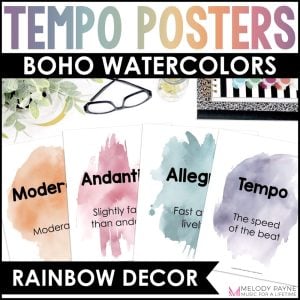
Tempo Terms and Definitions Posters – Boho Watercolor Music Classroom Decor
$5.00
Earn 5.00 Reward Points
Earn 5.00 Reward Points Add to cart -
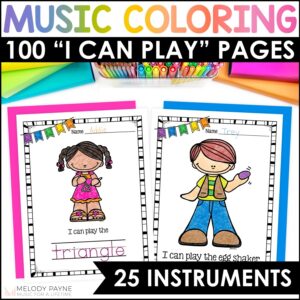
Musical Instrument Coloring Pages for Elementary Music Class – “I Can Play!”
$5.75
Earn 5.75 Reward Points
Earn 5.75 Reward Points Add to cart -

Beginning Piano Keyboard Worksheets for Music Class – Piano Keys Are A Breeze
$3.50
Earn 3.50 Reward Points
Earn 3.50 Reward Points Add to cart -
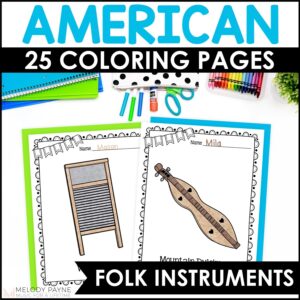
American Folk Instruments Music Coloring Pages – Elem. Music Coloring Sheets
Rated 5.00 out of 5$3.00
Earn 3.00 Reward Points
Earn 3.00 Reward Points Add to cart
You may also like…
-
Sale!
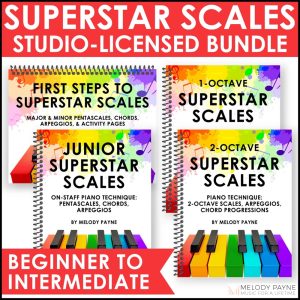
Piano Scales Books Studio-Licensed Bundle – Superstar Scales, Chords, Arpeggios
$300.00Original price was: $300.00.$280.00Current price is: $280.00.
Earn 280.00 Reward Points Add to cart -
Sale!
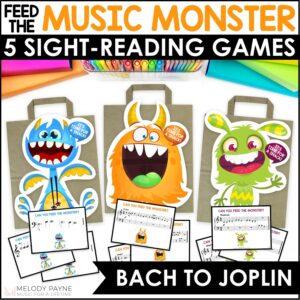
Bundle of 5 Sight-Reading Games Plus Ear Training – Feed the Music Monster Classical Favorites
Rated 5.00 out of 5$25.00Original price was: $25.00.$20.00Current price is: $20.00.
Earn 20.00 Reward Points Add to cart -
Sale!
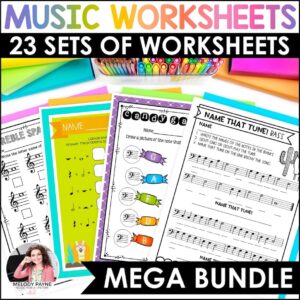
650+ Music Worksheets Mega Bundle – Piano & Music Class – Notes, Rhythm, & More!
$116.00Original price was: $116.00.$93.00Current price is: $93.00.
Earn 93.00 Reward Points Add to cart -
Sale!

200 Music Theory Worksheets – Music Class & Piano – Note Reading, Rhythm, & More
Rated 5.00 out of 5$24.00Original price was: $24.00.$22.00Current price is: $22.00.
Earn 22.00 Reward Points Add to cart

Reviews
There are no reviews yet.