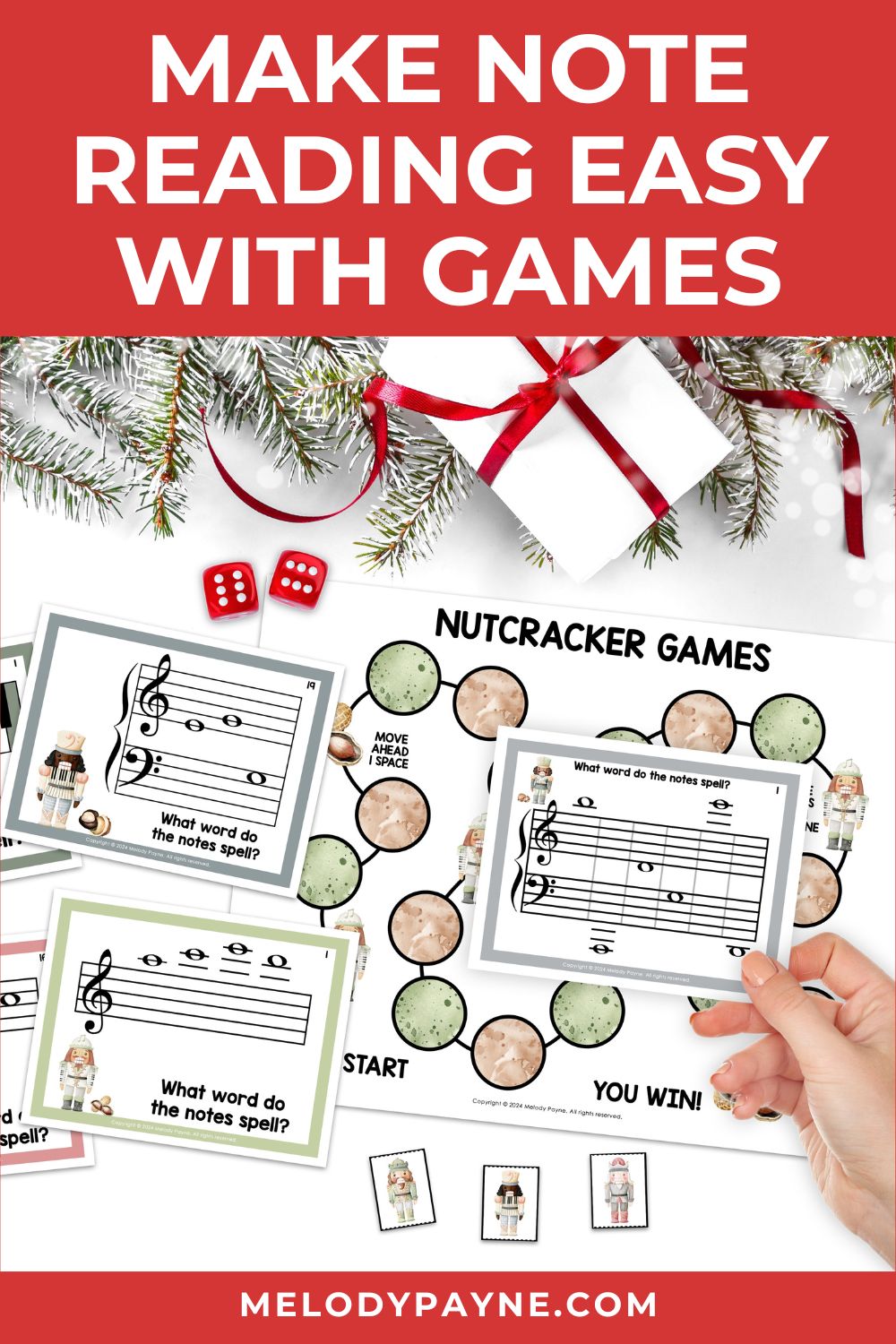
Research-backed holiday games that turn note reading practice into Christmas magic your students will actually beg to play! You’ll discover how these five progressive games align with Harvard’s findings on play-based learning, creative ways to use them in both private and group lessons (from tournaments to learning stations), and why the spelling bee format makes students forget they’re building essential music reading skills. Your students will develop incredible confidence in note identification while being completely captivated by the Nutcracker theme – they’ll be so engaged they won’t even realize how much they’re learning!
Table of Contents
Make Note Identification Easy with Nutcracker Note Reading Games
As piano teachers, we’re always looking for fresh ways to make note reading practice more engaging, especially during the festive season when students’ minds are filled with Christmas excitement and holiday plans.
The Power of Play in Music Learning
I’m so excited to share how these Nutcracker note reading games align with current research on play-based learning and how they can be the perfect treat for your students throughout the holiday season!
Recent studies show that music games are particularly effective because they match children’s natural psychological characteristics of “strong curiosity, short attention span, and playfulness” (Liu, 2023).
We learn from Harvard Graduate School of Education’s Project Zero and the Regional Educational Laboratory that play-based learning develops essential skills including:
- Critical thinking and creative innovation
- Collaboration and communication
- Confidence and content mastery
- Social and emotional growth
What I love most is that guided play can actually be more effective for teaching academic content than direct instruction for young students (Regional Educational Laboratory, 2022).
Music games help transform things students might consider to be “dull practice” into engaging learning experiences that fully capture students’ enthusiasm (Liu, 2023) – exactly what these Nutcracker games accomplish!
These games work especially well because they combine what researchers call “guided play” with specific learning goals.
As teachers, we provide the structure and educational focus (through the carefully designed note reading activities), while students get to explore and engage with the material in a way that feels natural and enjoyable to them.
How These Nutcracker Note Reading Games Engage Students in Piano Lessons
I absolutely love seeing students light up when they realize they’re becoming fabulous note readers through play!
These Nutcracker-themed games turn traditional flash card practice into engaging Christmas activities that work equally well for both private and group lessons.
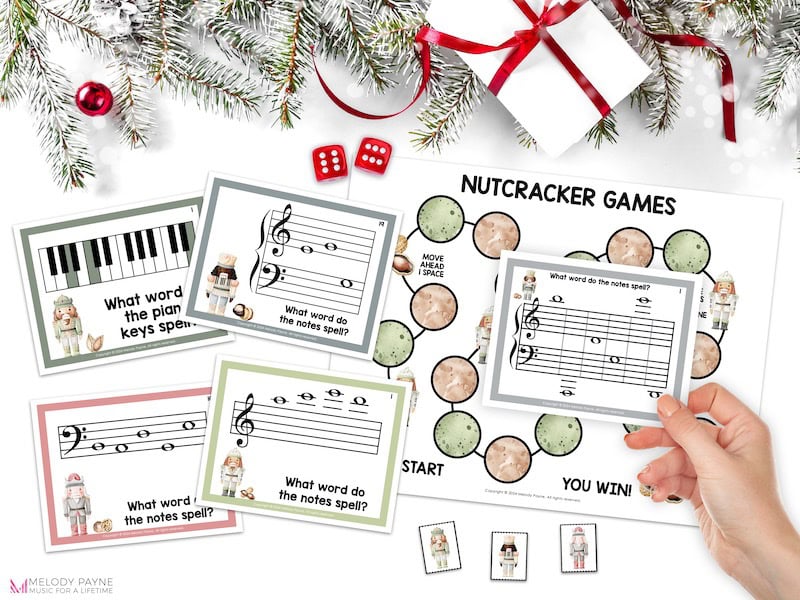
The complete bundle includes five progressive Nutcracker note reading games, pre-staff to intermediate levels, that build essential music reading and piano key recognition skills:
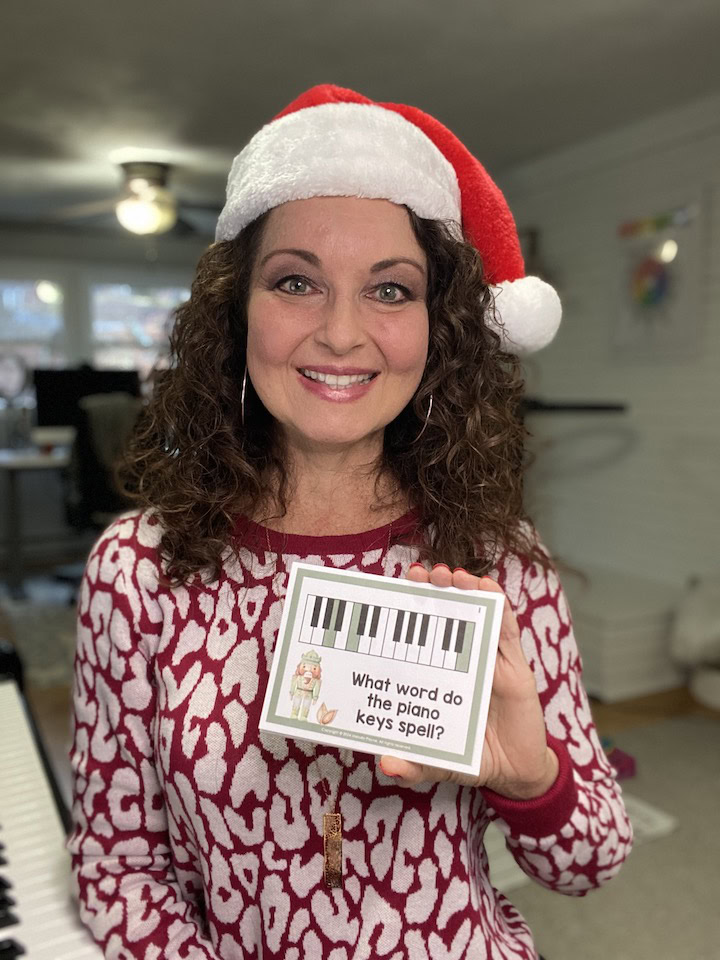
- Nutcracker Piano Keys Game: Perfect for beginners learning white piano key names.
- Middle C Nutcracker Note Reading Game: Introduces note reading in a comfortable, focused range for beginners.
- Treble & Bass Clef Nutcracker Note Reading Game: Expands note reading across both clefs.
- Ledger Lines Nutcracker Note Reading Game: Helps students learn those challenging ledger line notes.
- Grand Staff Nutcracker Note Reading Game: Brings it all together for complete staff reading understanding.
Creative Ways to Use Nutcracker Note Reading Games
Here’s how I love using these festive note reading activities in my studio:
Private Lesson Ideas:
- Use these Nutcracker note reading games instead of using traditional flash cards as a fun piano lesson warm-up activity.
- Use the score cards to help students figure out each musical spelling word.
- Let students be the “teacher” to reinforce learning.
- Use as an educational break between working on Christmas repertoire, such as the Nutcracker Suite.
- Use the cards to provide starting points for musical creativity through improvisation.
Group Lesson Activities:
- Host a Nutcracker note reading tournament:
- Split your group class into two teams and give each team 2 minutes to solve as many musical spelling words as they can.
- The team with the most correct words at the end wins!
- Create cooperative learning pairs:
- Have one student be the “card reader” while their partner writes down the letters.
- Switch roles after each word so both students get equal practice reading the notes on the cards.
- Pro Tip: Laminate the score cards or use a plastic sheet protector with dry erase markers to save card stock.
- Set up musical learning stations:
- Create three 10-minute stations – one for note identification with these Nutcracker note reading games, one for playing Christmas pieces, and one for Nutcracker sight-reading activities.
- Rotate small groups through each station.
- Organize a festive Nutcracker note reading bee:
- Line up students and give each one a musical word to spell.
- If they are correct, they stay in line.
- Keep going until you have a note reading champion!
- For the students who are no longer in line, give them score cards so they can participate by writing down the music spelling words.
Why Students Love These Nutcracker Note Reading Games
The most effective teaching approach is one that balances structured learning with playful exploration (Harvard Graduate School of Education, 2023).
These Nutcracker games strike that balance by:
- Empowering students to guide their own learning pace
- Creating opportunities for collaborative learning
- Making note reading practice actively engaging
- Adding an element of play to music theory fundamentals
- Allowing musical creativity and playful exploration through improvisation
What makes these note reading games so special is how they combine solid pedagogical progression with a favorite holiday theme – The Nutcracker.
Students are so captivated by the Nutcracker theme that they forget they’re building essential music reading skills!
The spelling bee format turns note reading practice into a fun challenge, and the seasonal theme makes these games perfect for piano lessons throughout the Christmas season.
You’ll love watching your students develop confidence in their note reading skills while having a fantastic time.
Ready to bring some note reading fun to your piano studio?
These Nutcracker note reading games will keep your students engaged and learning throughout the entire Christmas season and beyond!
I’d love to hear how you use these Nutcracker note reading games in your studio! Share your ideas in the comments below.
Frequently Asked Questions
Q: Can I use these Nutcracker games year-round, or are they only for Christmas season?
A: While they have a festive theme, these games work beautifully all year! The note reading skills are exactly the same whether it’s December or July. I’ve had students request their “favorite Nutcracker spelling game” in July!
Q: Which Nutcracker game should I start with for a student who’s just learning to read notes on the staff?
A: Start with the Piano Keys Game if they’re still learning white key names, then move to the Middle C game once they’re comfortable with the notes of Middle C position. The progression is designed to build systematically – don’t skip steps! A solid foundation with white keys and Middle C range will make the treble and bass clef games much easier later.
Q: My student finds the spelling bee format intimidating. How can I make it less pressure-filled?
A: Great question! Try turning it into a collaborative effort instead of competition – you and the student work together to “solve the puzzle.” I also use the score cards as hints, letting them use as many clues as they need. You can even let them take their time or give them multiple tries, or you and your student could take turns naming each note.
Q: How long should I spend on these games during a 30-minute lesson?
A: About 5 minutes is perfect! These work wonderfully as warm-up activities at the beginning of lessons or as a fun break between working on pieces. I often use them when I sense a student needs a mental break from challenging repertoire – the game format re-energizes them while still building essential skills.
Q: Can I modify these games for my adult students who might find the Nutcracker theme too childish?
A: Absolutely! Adult students often love the mental challenge of the spelling format. You can present it as “musical word puzzles” or “note reading brain teasers” rather than games. Many adults actually enjoy the nostalgic Nutcracker connection, and the beautiful watercolor artwork is appropriate for adults as well as children.
Q: My student struggles with ledger lines. Will the Ledger Lines Nutcracker game really help, or should I use a different approach first?
A: The game definitely helps, but make sure they’re solid with regular staff notes first! I usually introduce just one or two ledger line notes at a time through the game rather than overwhelming them with all possibilities. The spelling bee format actually makes ledger lines less scary because students focus on the word puzzle rather than feeling intimidated by the “difficult” notes. If my student only knows, for example, one ledger line note above the treble staff (A), I will identify the rest of the notes and have my student identify each A as we go through each music spelling word.
References
Harvard Graduate School of Education. (2023). Embracing learning through play. Harvard Graduate School of Education. https://www.gse.harvard.edu/news/uk/23/05/embracing-learning-through-play
Liu, Y. (2023). The Application of Music Games in Elementary School Classes. International Journal of Education and Humanities, 9(2), 205-208. https://doi.org/10.54097/ijeh.v9i2.9934
Regional Educational Laboratory. (2022). Prioritizing play: The importance of play-based learning in early education. Institute of Education Sciences. https://ies.ed.gov/ncee/rel/Products/Region/northeast/Blog/100779