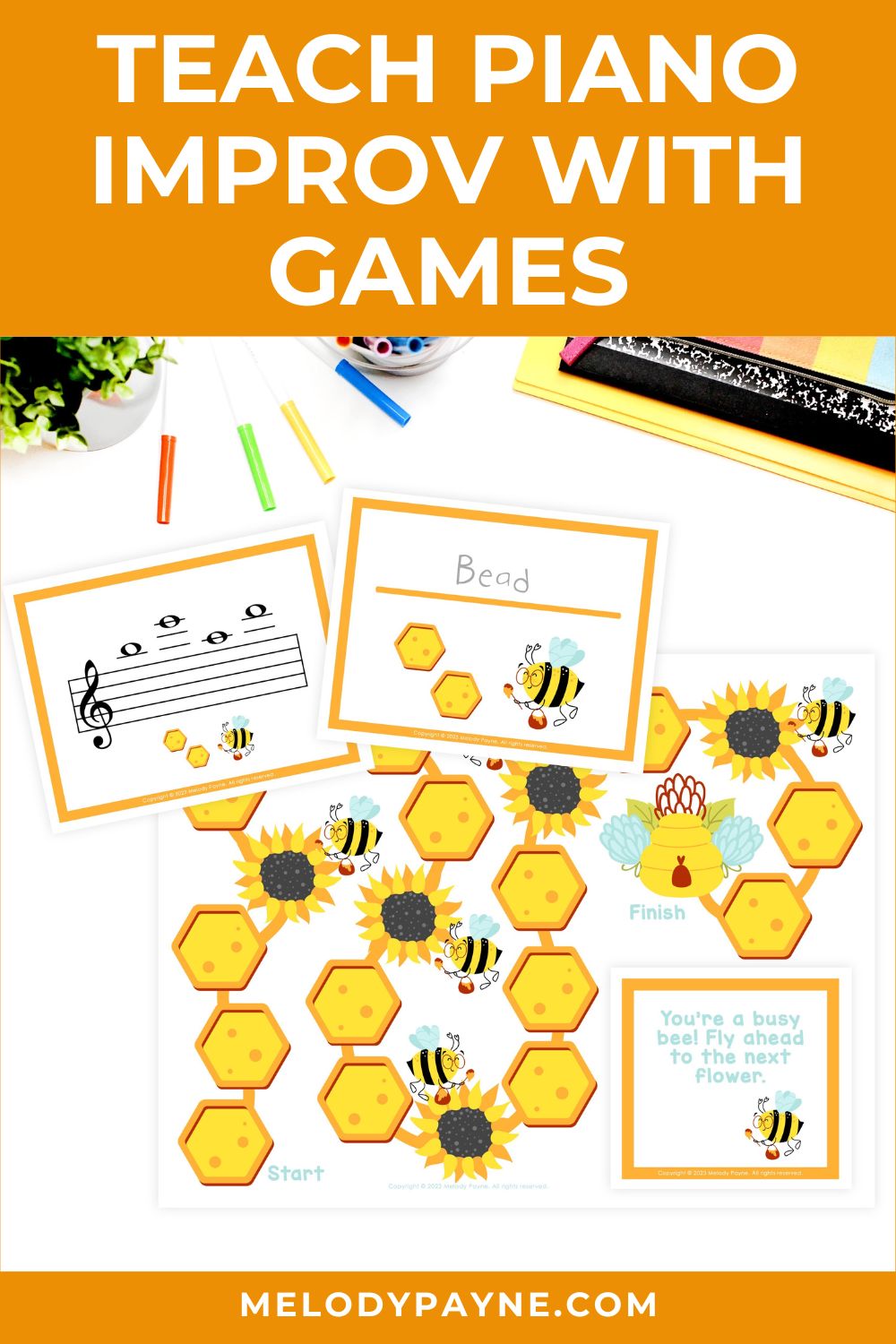
Inside: Ten simple strategies that make improvisation a regular part of both lessons and home practice! These tips include using music spelling bee games as warm-ups, setting timers for short focused sessions, creating musical conversations through call-and-response, and sending materials home for continued exploration. Students will build incredible confidence when they know improvisation only takes a few minutes, there are no wrong notes, and the whole process is meant to be creative and playful – plus they’ll love recording themselves and using backing tracks to make their improvisations sound even more amazing!
Table of Contents
Over the last few months, we have explored a lot about using games to teach improvisation to piano students.
Today, I thought we would focus on 10 tips that show other ways we can use games to teach improvisation to piano students.
If you’ve missed the last blog articles in our series, you will want to read them:
- 5 Good Reasons To Teach Piano Students How To Improvise
- 3 Advantages of Using Games to Teach Piano Improv
- Using Games to Teach Piano Students to Improvise
Now, for our 10 Tips for Using Games to Teach Improvisation to Piano Students: 5 in your studio, and 5 for students to take home!
Our goal with these is to show you how easy it is to incorporate improv for just a few minutes in any lesson or practice session.
Part 1: How to Teach Improvisation to Piano Students in Lessons
Once you start teaching improvisation in piano lessons, you’ll start seeing places to incorporate it regularly.
But, in case you need a few ideas, here are some to get you started–and most of them only take a few minutes!
1. Use Improvisation Activities As A Warm-Up
Start your lessons with a quick round of Music Spelling Bee Improv to get your students’ creative juices flowing (read our blog post Using Games to Teach Piano Students to Improvise to learn how to do this).
This can help them loosen up and get into a more improvisational and creative mindset before diving into the more structured part of the piano lesson.
2. Teach Improvisation to Piano Students by Setting A Timer For Short Sessions
Encourage your students to improvise for short periods of time, such as one or two minutes per music spelling word.
Setting a timer can also help keep the improvisation session focused and purposeful.
This is especially helpful if your student is intimidated by improvisation.
If they know they only have to “noodle” for a couple of minutes, they may give it a better try than if you ask them to do something open-ended.

3. Incorporate The Spelling Bee Improv Games Into Regular Lessons
Use the Music Spelling Bee Games as a regular part of your teaching routine to help your students develop their improvisation skills over time.
As they become more comfortable with the games, you can gradually increase the difficulty level and requirements and components of the improvisation activity to keep them challenged.
You can also level up with the different Spelling Bee Games (how cool would it be for a student who starts out with the piano keys version to work all the way up to the ledger lines, doing improv the entire way?!).
4. Improvise Conversationally
Encourage your students to experiment with different sounds, rhythms, and styles by demonstrating them for your student.
Play a short phrase on the piano and have your student respond with an improvised phrase using the notes from one of the cards from the Music Spelling Bee Games.
Then have a full musical conversation in call-and-response format.
This works well with teacher and student, and it also works well with student and student pairs who are more comfortable improvising on their own.
Remember to emphasize that there are no “wrong” notes in improvisation.
5. Provide Feedback And Encouragement when you Teach Improvisation to Piano Students
After an improvisation session, take a minute to provide encouragement to your students and support them to keep experimenting and developing their skills.
Positive feedback will build their confidence and motivate them to continue exploring the world of improvisation, especially if they’re still feeling a bit intimidated by the whole process.
By incorporating these tips into your piano teaching, you can use Music Spelling Bee Games to teach improvisation and help your students become more creative and confident musicians, all within an easy-to-implement set of parameters.
Part 2: How to Teach Improvisation to Piano Students so they can Work At Home
You might work hard to teach piano students how to improvise during their piano lessons, but what about their home practice?
How can your piano students continue working on improvisation at home?
Improvisation can be a fun and creative way to practice piano, but it can also be a challenging skill to develop.
Here are some tips on how to teach improvisation to piano students so they can practice improvisation at home.
6. Provide Improv Materials For Your Students
Send the spelling bee cards home with your students and have them draw a card, identify the notes, and create a short improvisation using the word on the card as inspiration.
7. Teach Improvisation to Piano Students by Using Backing Tracks And Accompaniments
Provide your students with backing tracks and accompaniments to practice their improvisation skills.
The iReal Pro app for iPad is a great option.
8. Record And Listen
Encourage your students to record their improvisation practice sessions and listen back to them.
This can help them identify things they love about what they did, as well as ideas for things they’d like to change the next time around.
9. Have Piano Students Practice Improvising Regularly
Like any other skill, improvisation takes practice to develop. Encourage your students to practice improvisation regularly, even if it’s just for a few minutes each day.
You can even go as far as to include it in their weekly assignment!
10. Have Fun when you Teach Improvisation to Piano Students
This tip applies to both studio time and home time.
When you teach improvisation to piano students, it’s vital to encourage them to have fun with improvisation!
Improvisation is a creative and playful process, and it’s important for your students to enjoy the process of exploring different musical ideas and experimenting with different sounds and rhythms.
What Tips Do You Have to Teach Improvisation to Piano Students?
I’d love to hear what has worked for you and your students in improvisation! Comment and share!
More Creative Blog Posts You’ll Love…